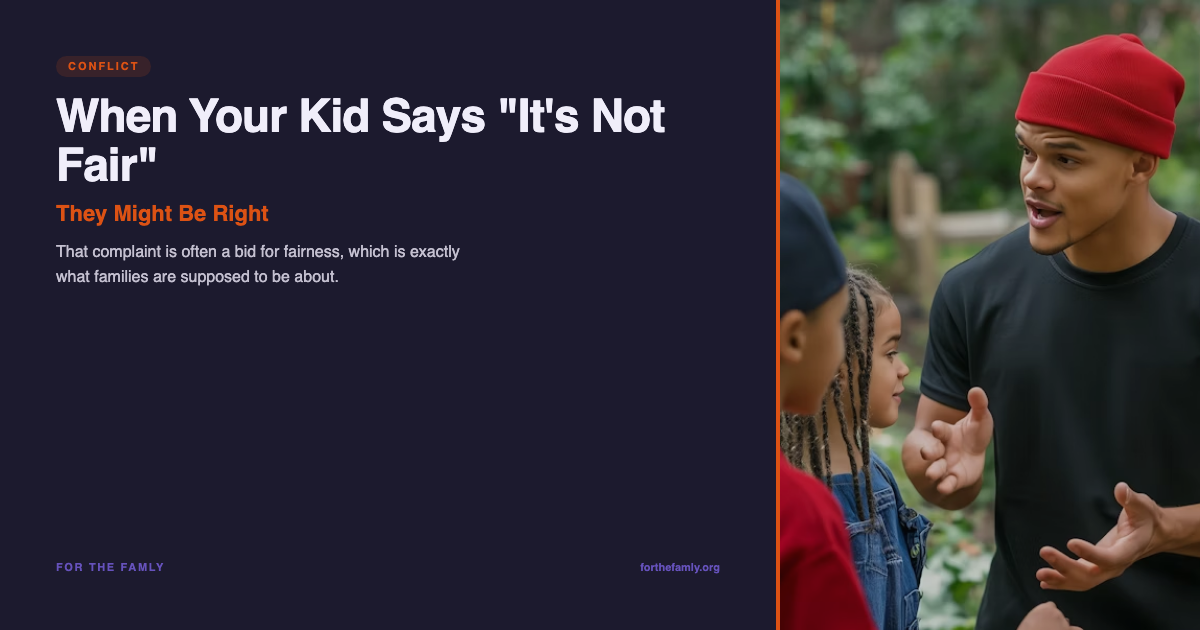
"It's not fair."
Every parent has heard it. Most of us have an immediate, visceral reaction to it. Something between exhaustion and irritation.
"Life isn't fair." "When you're older you'll understand." "Your sister has different rules because she's older."
We say these things. And they're not wrong. But they almost never land.
Why "Life Isn't Fair" Doesn't Help
When a kid says "it's not fair," they're not asking for a philosophy lesson. They're expressing something that feels real and painful to them, right now.
Dismissing it teaches them one thing: their feelings don't get taken seriously in this house. That's a lesson you don't want to teach.
The better move is to actually hear the complaint before you respond to it.
What Kids Mean When They Say It
"It's not fair" usually means one of three things:
1. They feel invisible. Their sibling got something they didn't. Their need wasn't seen. The underlying cry is I matter too.
2. They don't understand the reasoning. The rule feels arbitrary because no one explained why it exists. Kids have a powerful sense of logic. If they can't see the reason, they fill in the gap with "favoritism."
3. They actually have a point. Sometimes kids identify a genuine inconsistency. Parents are human. We're not always consistent. If you look at it honestly and they're right, say so.
The Response That Actually Works
First, don't defend. Listen.
"It sounds like that felt unfair. Tell me more."
That's it. Let them say the whole thing. You'll learn something.
Then, once they've said it all, you have options:
If there's a valid reason, explain it. "Your brother goes to bed later because he's three years older. When you're his age, your bedtime will move too." Make it concrete and time-bound. Kids can handle waiting when they understand when.
If they have a point, own it. "You know what, you're right. I didn't handle that the same way. That wasn't fair. Here's what I'll do differently." This is not weakness. This is the highest form of parenting. You're modeling accountability.
If it's just different circumstances, name it plainly. "Different doesn't always mean unfair. You and your sister have different needs, and I try to meet each of you where you are."
The Dangerous Trap: Equal vs. Equitable
Equal means everyone gets the same thing. Equitable means everyone gets what they actually need.
A kid with a learning challenge might get more support with homework. That's not unfair to the other kid. That's good parenting.
When you explain the difference in kid-friendly terms, most children can understand it. "We don't all eat the same amount either - you eat more when you're hungry, right? Same idea."
When the Same Complaint Keeps Coming Up
If a child is constantly raising fairness concerns about a specific issue, that's a signal. Something in that area probably needs a real look.
Pull them in. "You've brought up the screen time thing a few times. I want to hear you out. Let's sit down and figure out something that works better for everyone."
That's not giving in. That's good governance. The goal is a home where people feel their concerns actually go somewhere.
Teaching the Bigger Lesson
Every fairness conversation is a chance to show your kid what it looks like to take someone seriously, think about it honestly, and respond with integrity.
That's the skill they're going to need in every relationship for the rest of their lives. Peer conflicts. Work dynamics. Their own future family.
When you model it now, you give them something worth more than any ruling you'll ever make.